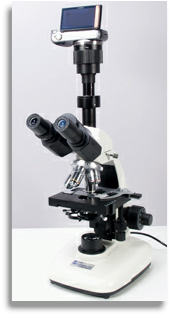
Taking photographs with a microscope is relatively straight forward providing a few basic principles are recognised. Traditionally photomicrography was confined to the use of SLR cameras as these have removable lenses.
If the lens is removed and the camera back attached to a microscope (with an appropriate adapter) this then in effect becomes the lens system for the camera back. The view finder will then look through the microscope which can be focused. The camera control should be set to manual (usually position P) and for normal specimens the exposure will look after itself. If your camera has the ‘live view’ option, then the specimen image can be viewed and focused using the LCD screen. The only exception being that some digital SLR cameras need electronic feedback from the lens system in order for the shutter to fire, and although they may have the live view option they will not work with microscopes. We have a number of photomicrography attachments that will fit all the microscopes in our range. Most can be used with the standard eyepieces supplied with your microscope however they will produce some vignetting that will leave the periphery of the image out of focus. photoeyepieces are designed to prevent this problem and can be provided with our photography attachments.
Almost all SLR cameras without live view have heavily frosted viewing screens that can make focusing problematic when they are attached to a microscope. For older models, without live view, a possible solution is a parallax photography system which allows the specimen and the camera to be focused through a forward facing periscope. This is only suitable for trinocular microscopes.
Should you need specific advice please email the make and model of both your camera and microscope, and technical support will endeavour to assist -
photomicrography

home photomicrography digital image capture cctv cameras and monitors video microscopes current recommendations site map