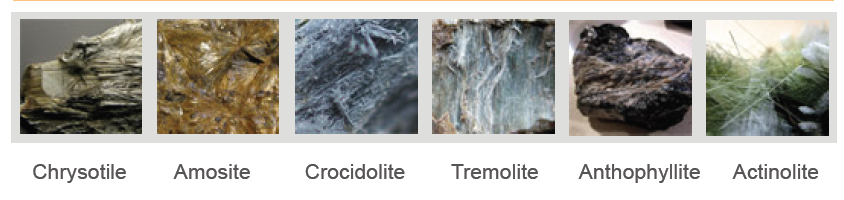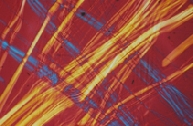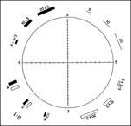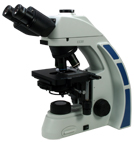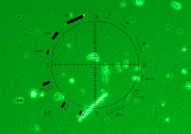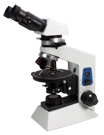





The microscopy requirements for the identification and particle counting of asbestos are exacting, and are fully described in several publications of the Health and Safety Executive. Brief reference to the types of microscopy recommended for the identification and counting of asbestos fibres is made here. Full information should obtained from the referenced publications of the HSE (www.hsebooks.co.uk), and to the European Directive on Worker Protection against Asbestos (Official Journal on the European Communities, L263, 24 September 1983). The HSE publication “Asbestos in Bulk Materials” (MDHS 77) recommends the following. 1. A low power, good quality stereomicroscope should be used for the initial search of samples for suspected fibres. “...examination of insulation samples and many manufactured products under the stereomicroscope will aid the detection of fibres and allow some initial assessment of the number of fibres types present”. Brunel Microscopes recommends the BMZ stereomicroscope on illuminated stand ST3 for this purpose. 2. For the identification of asbestos fibres by polarised light microscopy (PLM), a polarising microscope capable of Kohler illumination with a clear list of qualifying criteria is described. In addition a dispersion staining objective (McCrone objective) with a x10 magnification is required to aid the assessment of fibre RIs by producing intense dispersion staining colours. The Meiji ML9000 polarising microscope fits the specification described in (MDHS 77). However ML9000 is not supplied with a McCrone objective as standard, these can be supplied as an accessory item if required. Asbestos reference samples can be obtained from the Institute of Occupational Medicine, 8 Roxburgh Place, Edinburgh. EH8 9SU. (tel: 01316675131) 3. Asbestos particle counting by phase contrast microscopy has very specific requirements, and there are relatively few microscopes that can meet the phase contrast optical performance. The Health and Safety Laboratory (HSL) have developed a test slide, and its purpose is to provide a reproducible phase object to check the suitability of microscope phase systems for asbestos fibre counting. The test slide has 7 bands of 20 lines each, and the width of the lines in each band decreases. HSL categorises phase contrast microscope systems according to their ability to visualise the lines in the 7 bands. The small number of phase microscopes that are proved satisfactory are categorised into two sets. 1. Those that have band 4 lines fully visible and band 5 partially visible - these are given red documentation 2. Those that have band 5 fully visible and band 6 partially visible - these are given green documentation. The microscopes that meet either the red or green documentation are suitable for asbestos fibre counting. The Meiji ML2870 meets the green documentation standards and we believe that it is the lowest price microscope on the market to do so. The use of the test slide is required by the HSE to ensure microscopes are properly adjusted when testing for compliance with the UK asbestos control limits. This is described in the HSE publication MDHS 39 (paragraph 20.b)